
San Martin SN0151 GL Diver Watch - Miyota 9015 Movement
Discover the San Martin SN0151 GL automatic dive watch featuring a stunning guilloche MOP wave dial, powered by the reliable Miyota 9015 movement. With a water resistance of 200m, this 39mm wristwatch is perfect for diving enthusiasts and stylish enough for everyday wear.
DIVE WATCHES
2/10/202610 min read
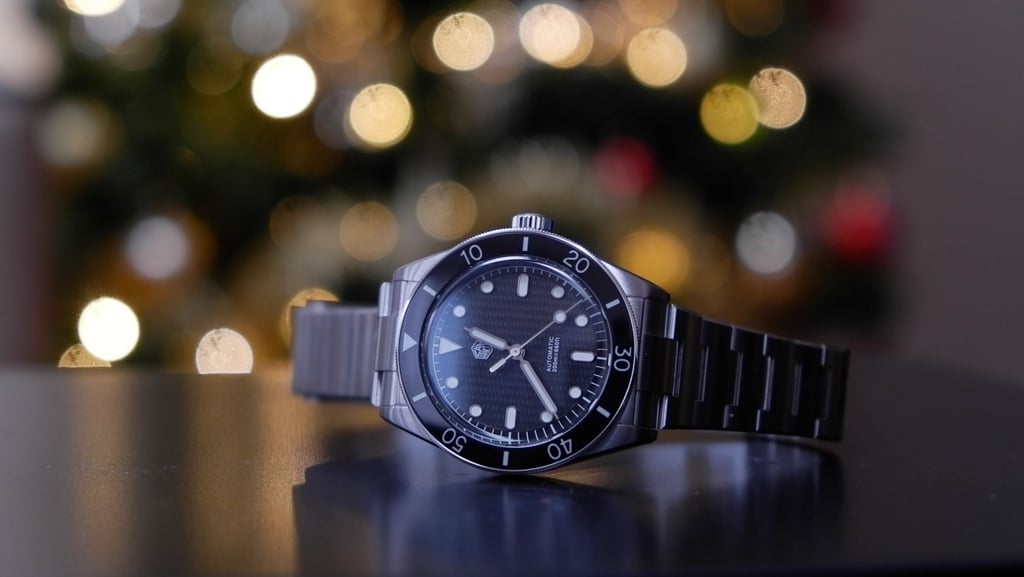
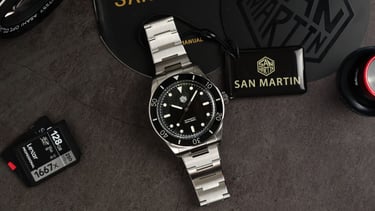
This might be one of the most refined divers San Martin has ever made. An original design, a guilloché mother-of-pearl dial, and a bracelet that’s been very thoughtfully executed, and I'm being really modest. And yet… despite all of that refinement, there are a couple of decisions here that genuinely left me scratching my head. Not exactly bad decisions — just strange ones. So their most refined diver to date he says? Well we got it here - let’s find out!
...
Design
So let’s start with the design — because this is actually a very interesting one. First things first: this is very much an original design from San Martin. Now, if I had to point to a loose aesthetic inspiration, I think a lot of people will pick up on Tudor Black Bay–style cues, particularly something along the lines of the Black Bay 54 or early Black Bay 58 language. But this is definitely not a clomage. It’s more about proportions, restraint, and overall mood than any direct reference.
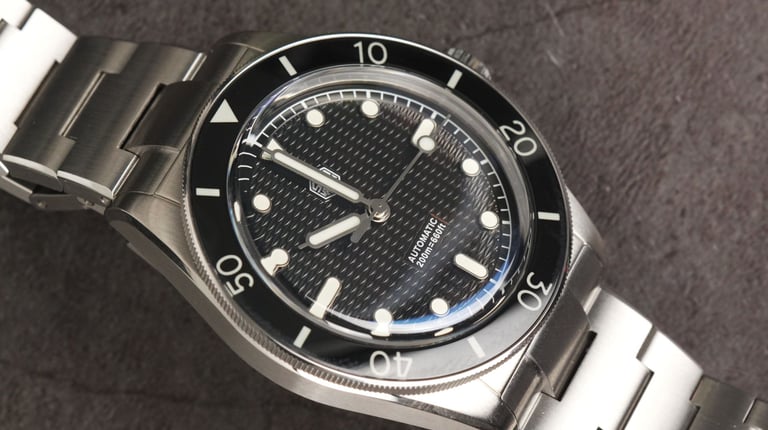
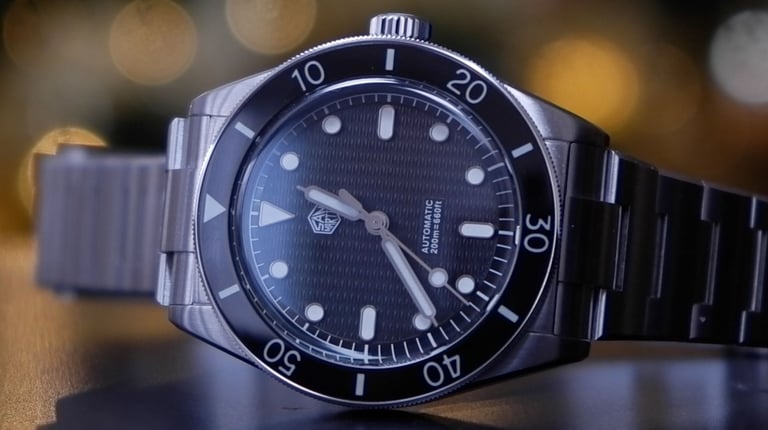
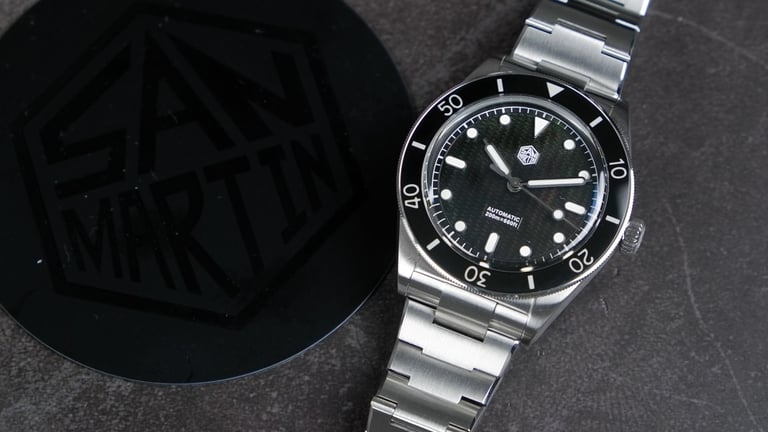
We’ve got a clean, almost monochrome theme running throughout, and I think it works extremely well here. The dial layout is nicely balanced and uncluttered, and — importantly — there’s no date window, which immediately gives the watch a more focused, symmetrical look.
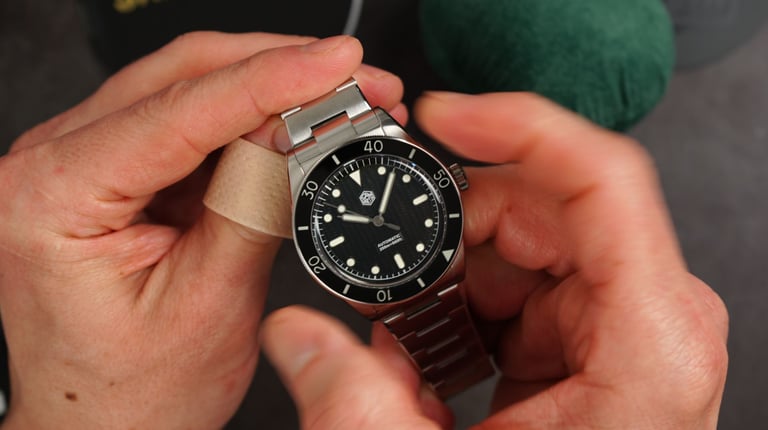
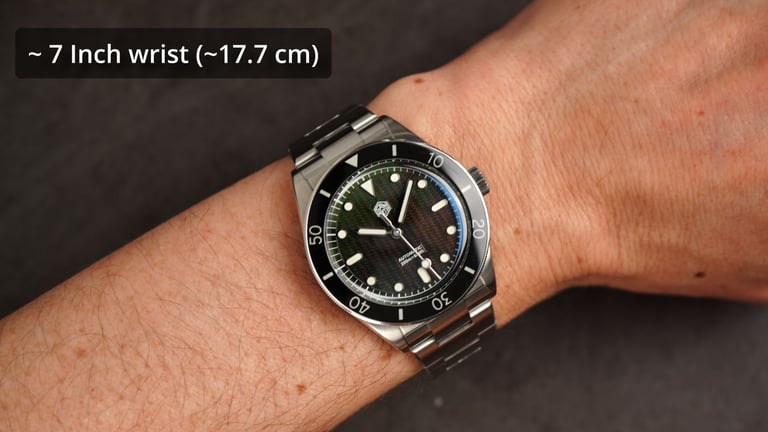
The case design leans into a vintage-inspired diver aesthetic and there are no crown guards, which adds to that old-school charm, and the overall silhouette feels compact and purposeful. Dimension-wise, it does come in slightly larger than something like a Black Bay 54 — we’ll cover the exact measurements shortly — but it still sits firmly in that compact, wearable category.
Now, there are two areas that really stand out — and interestingly, they’re also the two areas that for me raised the most questions.
The first is the dial, with its guilloché-style texture combined with subtle mother-of-pearl. It’s visually striking, unusual, and not something we see very often in this segment. The second is the bracelet, which is genuinely different from anything I’ve seen from San Martin before. At first glance it follows a familiar three-link formula, but once you look closer, it’s clearly been elevated with more refined shaping and finishing.
At the same time, both of these elements made me pause. Not because they’re poorly executed — quite the opposite — but because some of the choices here didn’t immediately make sense to me. And that’s something I’ll come back to when we look at the dial and bracelet in more detail.
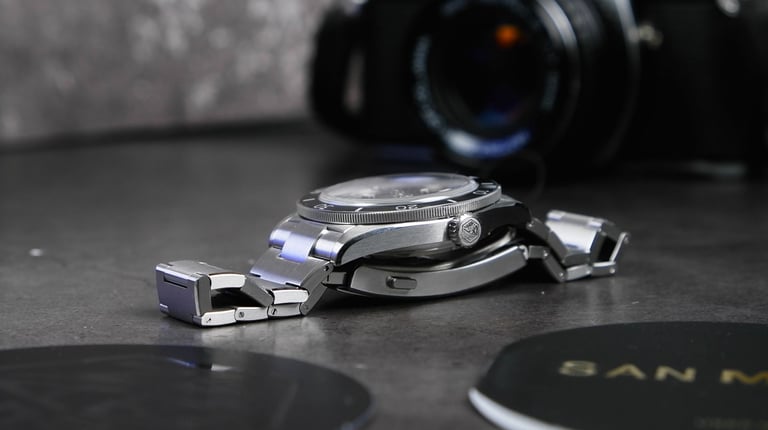
Now another interesting design element here is the actual case. One thing San Martin does from time to time — and they’ve done it again here — is play a subtle visual trick with the case profile. The way the flanks are made to appear thinner, combined with the bezel and crystal proportions, helps the watch appear slimmer and more compact on the wrist than the raw numbers might suggest. It’s understated, but it works.
Dimensions
Quickly running through the dimensions.
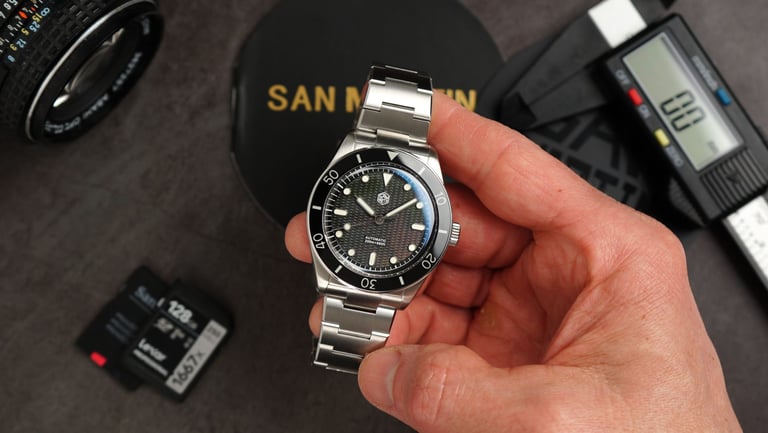
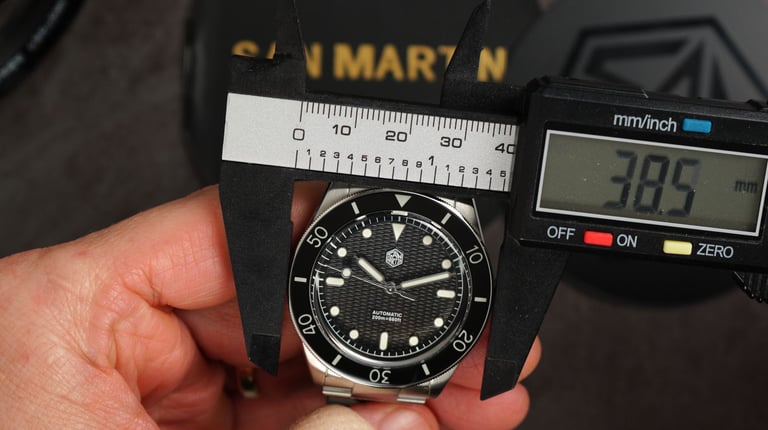
The case diameter is 38 millimeters, with the bezel just slightly overhanging that — coming in at about 38.5 millimeters overall. It’s a subtle difference, but it does add a touch more visual presence.
We’ve got 20 millimeter lugs, keeping that classic one-to-two proportion, which always works well in terms of balance and strap options.
Looking at lug-to-lug, the case itself measures just over 45 millimeters — about 45.2 to be exact. Now, this watch does use protruding end links, which extend the full end-to-end wingspan to roughly 48.7 millimeters. That sounds bigger on paper than it feels in reality, and it remains very manageable on most wrist sizes. And the case height is 11.1 mm.
And finally, weight: on the supplied stainless steel bracelet, this comes in at around 132 grams. So it feels solid and well-built, but nowhere near heavy or cumbersome — definitely not something you’d mistake for a lightweight toy.
Case
Now let’s talk about the case. It is very nicely sculpted, and a big part of why it wears so well comes down to the comparatively thin case flanks. That slim mid-case profile visually compresses the height and makes the watch appear even slimmer on the wrist than it already is.
Running along the top edge of the flanks, we’ve got a clean, elegant polished chamfer, which adds just enough refinement without breaking the tool-watch character. Everywhere else, the finishing is kept purposeful — fine satin brushing across the tops of the lugs and along the case sides. It’s even, consistent, and well executed.
There are no crown guards here, which reinforces that vintage-inspired aesthetic we mentioned earlier. The signed screw-down crown itself is very good — nicely proportioned, easy to grip, and it gives off strong vintage Submariner vibes thanks to the knurling. Engagement is smooth and positive, helped by the Miyota 9000-series movement inside.
Flip the watch over and you’ll find a screw-down caseback with a pretty rudimentary circular brushing, which, together with the crown, helps achieve the 200 meters of water resistance. The caseback does protrude slightly, but that’s largely because the mid-case is kept so slim — and on the wrist, it essentially disappears, settling comfortably and giving the watch a very slender, well-balanced look.
Crystal
Now, we haven’t mentioned the crystal yet, but it’s actually very nicely done.
Up top, we’ve got a slightly raised, box-style sapphire crystal with a gentle double dome. Visually, it works really well and adds to that vintage-inspired look without introducing any distracting distortion.
San Martin has applied multiple layers of anti-reflective coating, and in practice it does a solid job controlling reflections and keeping the dial legible in most lighting conditions. Personally, I wouldn’t mind seeing an even stronger AR — something closer to that near-invisible effect you get from Omega — just to really let the dial pop.
That said, at this point, we’re splitting hairs. Overall, it’s a very well-executed sapphire crystal that suits the watch perfectly.
Dial & Lume
Now let’s talk about the dial.
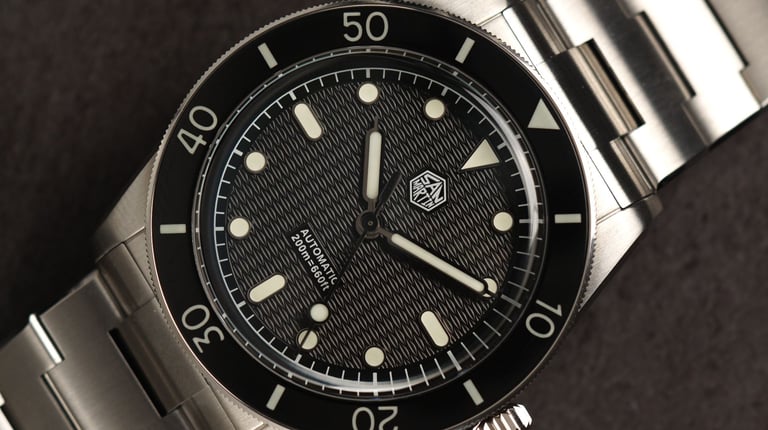
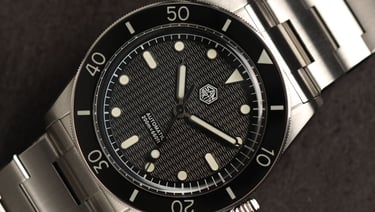
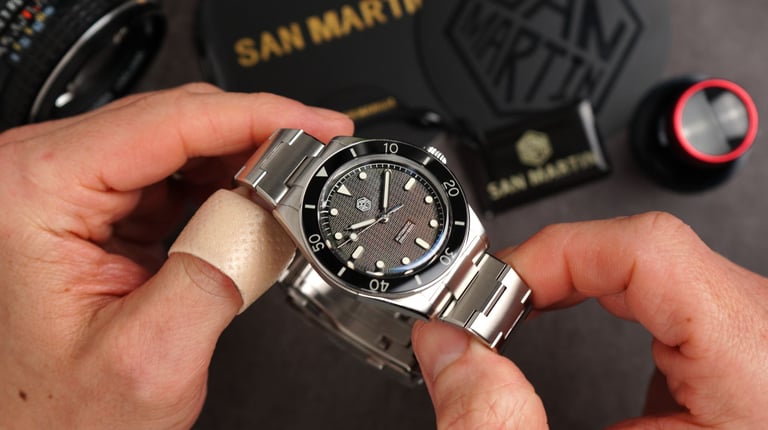
The background features a very intricate, wave-shaped guilloché-style pattern. And despite this being one of the headline features of the watch, it’s actually quite subtle. If you weren’t told it was there, it would be easy to miss at first glance.
The same — if not more so — applies to the mother-of-pearl layer. The color play only reveals itself at very specific angles and under certain lighting conditions. Most of the time, the dial reads as almost fully monochrome — calm, restrained, and understated. And that does raise an interesting question: why go through the effort of adding mother-of-pearl at all? The watch would arguably still work beautifully as a clean black guilloché dial. Maybe I’m missing something — let me know what you think in the comments. That said, when the effect does appear, it does feel genuinely special.
One nice side effect of this layered construction is how the applied indices present themselves. The rounded markers — including the cardinal positions — appear to float slightly above the dial, rather than being pressed into it. It adds depth and separation, and it looks very good in person.
The handset is another strong point. It’s more distinctive than what we’ve seen from San Martin in the past and works well with the rounded indices, creating a cohesive, original look.
And finally, lume. Lume performance here is excellent — bright, long-lasting, and applied not just to the dial and hands, but also to the bezel. It easily lasts through the night, and it’s great to see San Martin leaning back into strong lume execution again.
Bracelet and Clasp
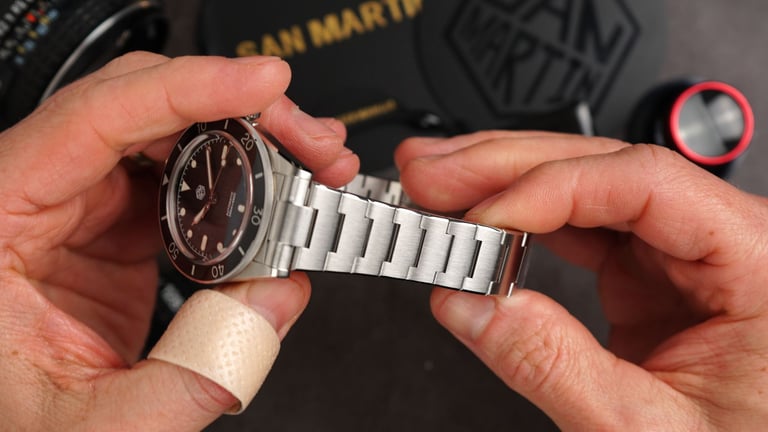
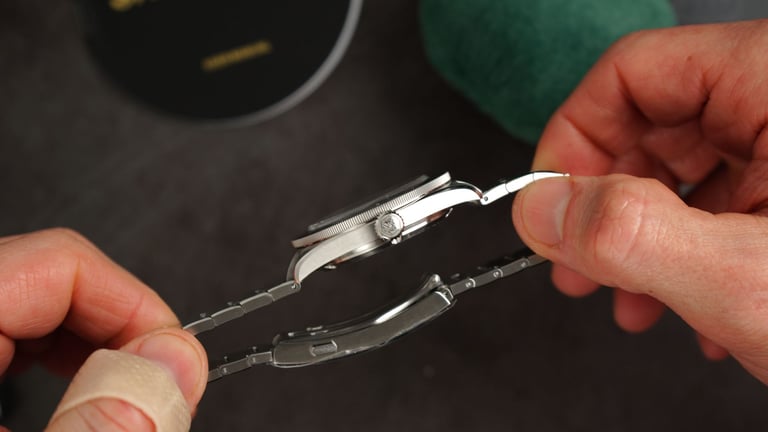
Now we come to the second headline feature of this watch — the bracelet — and this one genuinely surprised me. At first glance, you might think it’s a familiar Oyster-style layout. But look closer, and you quickly realize this is not a standard execution at all. One of the first things you notice is how tight and fluid the links look when viewed straight on. There are virtually no visible gaps between the links, and that’s because of how they’re constructed. If you look at the bracelet from the side, you can see that the links are shaped to slot into one another, almost interlocking. It’s slightly over-engineered, sure — but the result is a bracelet that feels incredibly smooth, cohesive, and refined.
Add to that the high-polished chamfers along the sides, fine brushing on the tops, and screws connecting the links, and you end up with a bracelet that feels genuinely premium. There’s a real sense that time was spent designing this — it doesn’t feel generic or off-the-shelf at all.
That said, this is also where my second question comes in. With all this attention to detail, the integration of the protruding end links is… interesting. From the sides, they sit flush and wear beautifully, and on the wrist they work absolutely fine. But when you look closely at how the back of the end link meets the case, there are some unusual gaps. They don’t ruin the look — in fact, I barely noticed them at first — but once you do spot them, you can’t help but wonder why San Martin chose this particular solution. Again, not necessarily a flaw — just a curious design choice. Let me know what you think in the comments.
This watch is also available on a tropical-style rubber strap, but honestly, I’d strongly recommend going for the bracelet. It’s excellent.
Rounding it out, we’ve got San Martin’s latest milled clasp with their on-the-fly micro-adjustment system. It’s solid, intuitive, and very convenient. I’ve even shown it to non-watch friends, and they were genuinely impressed by how well it’s put together.
On the wrist, the bracelet wears beautifully — smooth, comfortable, and well balanced. Overall, it’s a standout piece and a big part of what makes this watch so enjoyable to live with.
Verdict
So let’s talk pricing. This watch comes in at around $315 on the tropic-style rubber strap, and about $345 on the stainless steel bracelet, both before tax. And to me, that’s very competitive pricing for what you’re getting here. When you look at other microbrands offering a similar style, a Miyota 9000-series movement, and this level of refinement, San Martin has positioned this really well.
Add in the exclusive discount codes I’ve shared, and the value proposition becomes even stronger.
Overall, this feels like a seriously well-engineered piece — thoughtfully designed, well executed, and very comfortable to live with. It delivers exactly what it sets out to do, while offering its own take rather than feeling like a straight copy.
Bezel
One area where I have zero real questions is the bezel — this is close to a perfect execution.
And that actually says quite a bit, because I genuinely can’t recall a poorly executed bezel from San Martin to begin with. They usually punch well above their price point here, and this one takes things a step further.
We’ve got a coin-edge bezel, and grip is excellent — comfortable, secure, and easy to operate. Resistance is pretty much spot on. If I’m really splitting hairs, it might lean just a touch on the lighter side, but honestly, that’s nitpicking. The action itself is very good: very consistent, high-pitched, ball-bearing–like clicks, zero back play, no lateral wobble, and alignment on this sample is absolutely spot on.
Functionally, it’s a 120-click, unidirectional diver bezel with a ceramic insert, and everything is fully lumed. And yes — it looks very cool. The lume is strong enough that you can genuinely read the bezel well into the night.
That said, this is where I’ll raise one small question. From a pure tool-watch perspective, I sometimes wonder whether a brighter lumed triangle alone might actually be more practical than a fully lumed bezel. It looks fantastic, no doubt — but in terms of instant readability, a single, high-contrast reference point can arguably work better.
Still, taken as a whole, this is one of the best bezels San Martin has done — and that’s saying something.
Movement
Now, an important part of the overall design approach here is the movement choice.
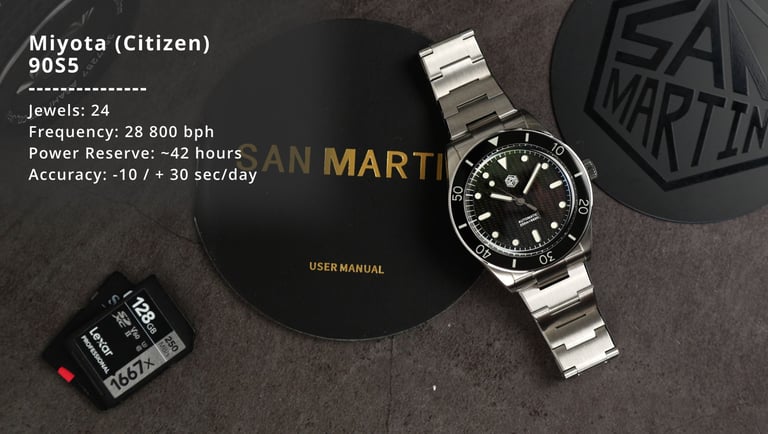
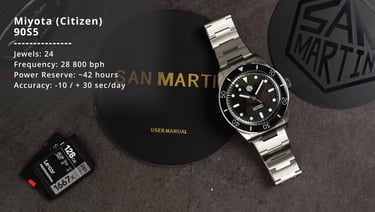
This is a no-date watch, and inside we’ve got a true no-date movement — the Miyota 90S5 from Miyota’s premium 9000-series. That means no ghost date position on the crown and no unnecessary compromises in execution.
One of the key advantages of this movement is its low overall height, and just as importantly, its low pinion height. That combination gives designers far more flexibility, allowing for a slimmer case construction and letting the crystal sit lower and closer to the dial. You can really see the result here — the watch wears noticeably thinner and more compact than you’d expect from a 200-meter diver.
The 90S5 runs at 28,800 vibrations per hour, delivering a smooth seconds sweep, and it has a strong reputation for reliability and long-term durability. It also stacks up very comfortably against entry-level Swiss automatics based on ETA-style architecture, like the 2824 and its modern equivalents.
We don’t get an exhibition caseback here, but for a diver, that’s perfectly fine — function over flash.

Explore
Discover expert watch reviews and industry insights.
Connect
Follow
© 2025. All rights reserved.